An Analysis of
Arborsculpture
ar·bor·sculp·ture
/ ˈɑːrbər ˌskʌlptʃər / noun
The botanical art of training, bending, and grafting living trees into ornamental or functional structures. By carefully manipulating young, flexible branches, sculptors can create living furniture, fences, geometric patterns, and complex architectural designs over several years.
Also known as tree shaping.
Respect to Master Arborsculptors


Arborsculpture: Solutions for a Small Planet by Richard Reames
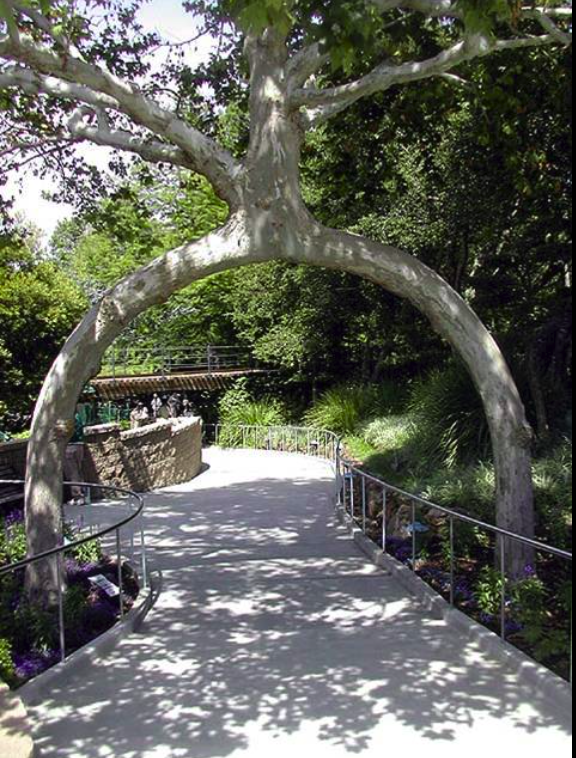
Axel Erlandson's Two Legged Giant at Gilroy Gardens
While most people have to cut, weld, nail or screw materials together to make a structure, arborsculptors "suggest" trees to do this themselves, bending the growth of trees to their will. The result is a living and breathing thing you can walk on, sleep on, or use as you would any other structure. Amazing!
Arborsculpture as a Structural Engineering Discipline
Arborsculpture is the deliberate shaping of living trees into functional, load-bearing structures. Unlike traditional construction, which assembles inert materials cut from nature, arborsculpture works with biological growth processes - leveraging the tree's own metabolic activity to produce continuously reinforcing, self-repairing structural members.
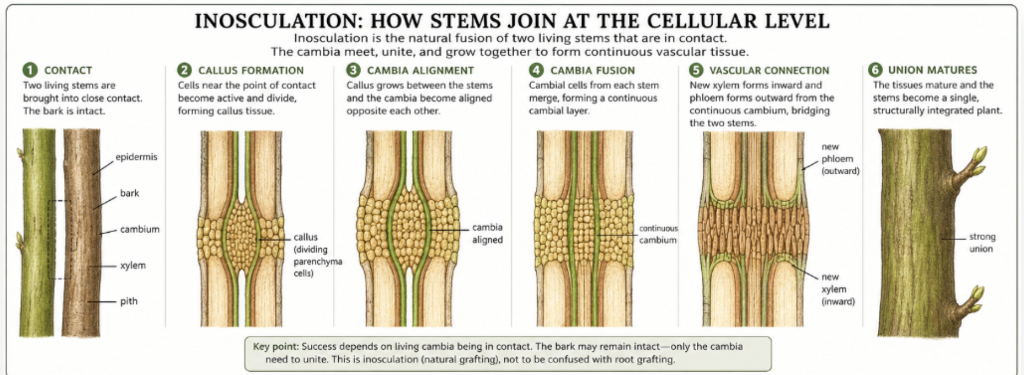
The key structural mechanism is inosculation - the natural fusion of two adjacent cambium layers when pressed into sustained contact. Where branches or roots of the same or compatible species are bound together, their vascular tissues merge, forming joints that are not mechanically fastened but biologically continuous. Over time these joints become stronger than the surrounding wood, eliminating the failure points that dominate conventional bolted or welded connections.
History
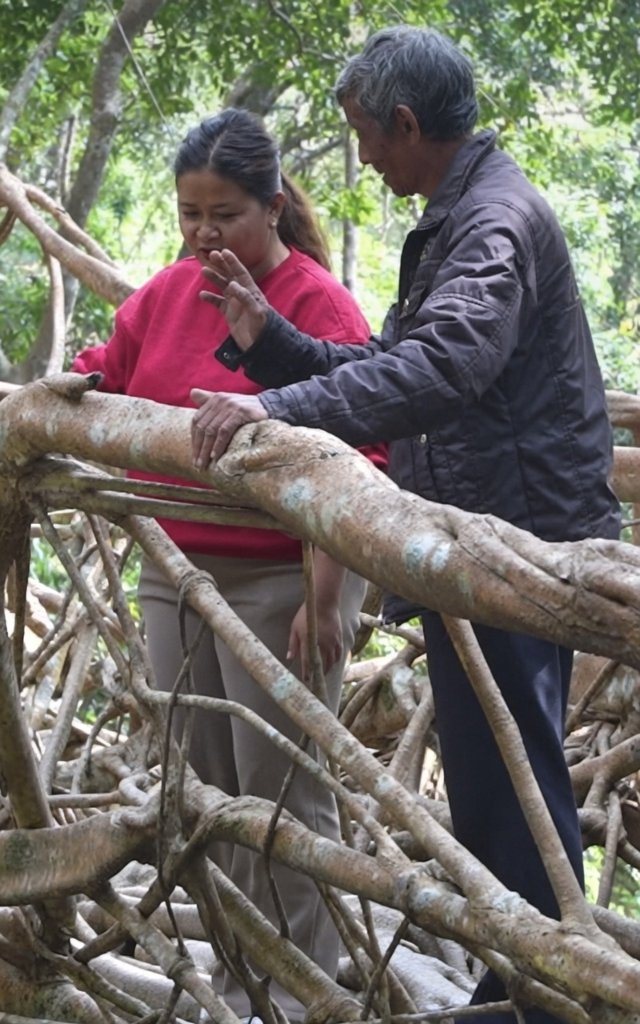
The practice of having someone else, or in this case something else do the work for you is as old as humanity. Indigenous communities across South and Southeast Asia have shaped living root bridges for centuries, with the Khasi people of Meghalaya, India, producing pedestrian crossings from Ficus elastica aerial roots.
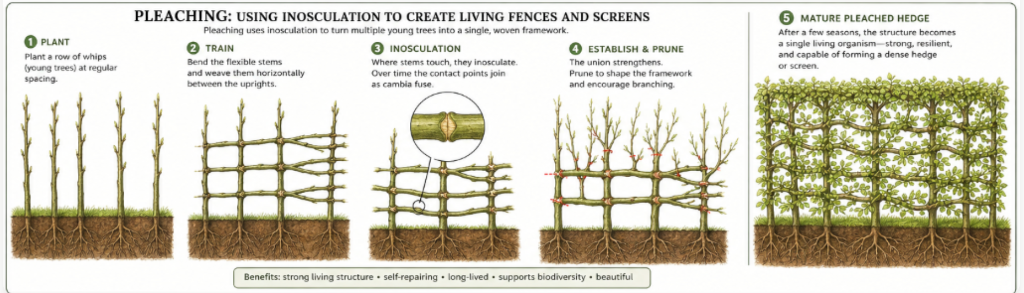
In Europe, much later, around 1500-1700, the same technique was applied to making fences, creating early "gated communities".
Recently, in the 1990s, Richard Reames ginned up interest in the technique, leveraging the momentum of the green movement. He documented several techniques into what became "the how" of modern Arborsculpture.
In the early 2000s, Karl Niklas at Cornell University elevated the practice to scientific plant biomechanics, by providing the quantitative foundation needed to treat wood as a certifiable engineering material, analysing growth stress, modulus of elasticity, and failure modes under controlled loading conditions.
Two Major Variants of Practice
1. In-Situ Shaping
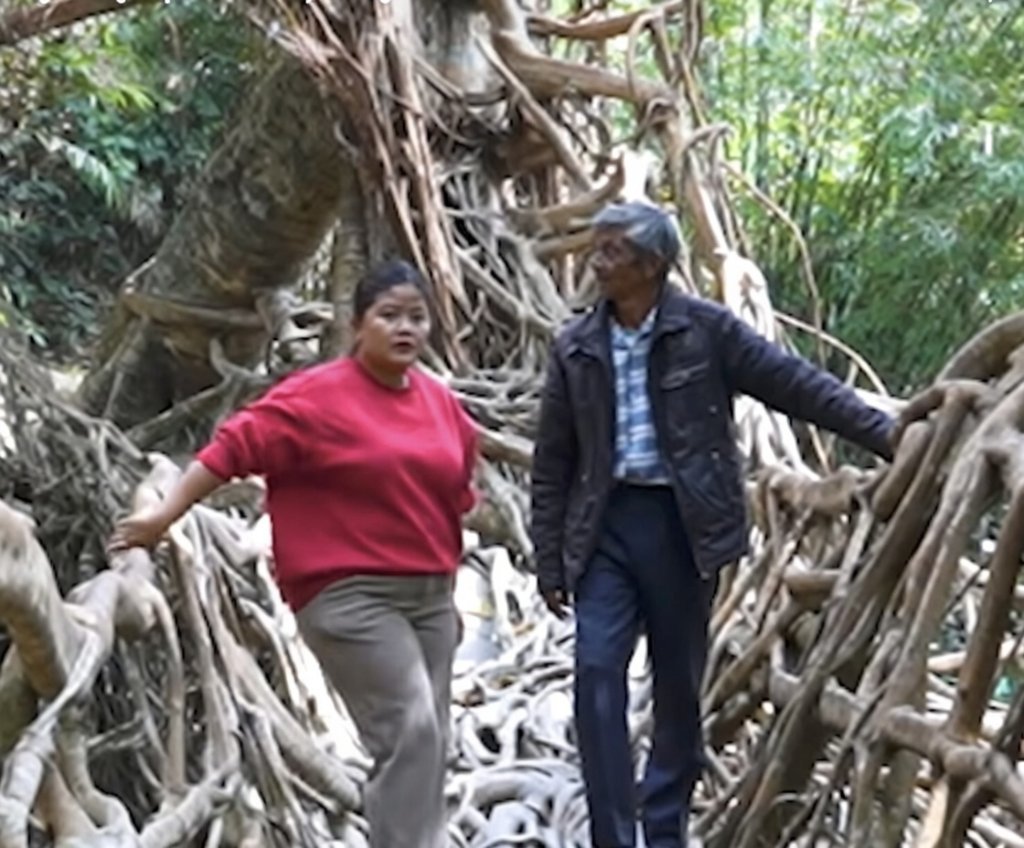
In-situ arborsculpture plants and shapes trees directly at their intended permanent location. Young saplings are positioned in the desired structural geometry and guided using non-invasive frames, ties, and grafting as they grow. This approach is suited to fixed infrastructure - bridges, living fences, permanent architectural features - where the final location is known from inception and multi-decade maturation timelines are acceptable. The principal advantage is minimal transplant stress and unrestricted root development into native soil. The constraint is inflexibility: the structure cannot be relocated, and any design change requires years of regrowth.
2. Aeroponic Pre-Formation
Aeroponic pre-formation - the variant underpinning TreeGridTowerZ - grows and shapes trees in a controlled facility before deployment to the field. Roots are suspended in a misted aeroponic chamber, delivering oxygenated nutrients directly to the root zone. This accelerates growth 3–5 times relative to soil cultivation and allows precise environmental control over moisture, temperature, and nutrient composition. Crucially, it decouples the shaping process from the deployment site. Trees are cultivated into their target structural form - tripod, lattice column, or branched apex - over 2–4 years in the facility, then transported and planted at remote tower sites. The aeroponic root architecture, compact and fibrous rather than laterally spreading, facilitates transport and rapid establishment. This variant transforms arborsculpture from a localised craft into an industrially scalable supply chain.
LandShifterZ & TreeGridTowerZ
LandShifterZ is the design and development entity that conceived and holds the intellectual property for the TreeGridTowerZ system. Its contribution to the discipline is the synthesis of aeroponic pre-formation with telecommunications infrastructure requirements - treating the shaped tree not merely as an architectural novelty but as a certified load-bearing mast engineered to precise payload specifications.
The LandShifterZ methodology adds three layers to conventional arborsculpture practice. First, species selection is governed by structural performance data - wood density, modulus of rupture, and long-term creep behaviour under sustained lateral load - rather than aesthetic or agricultural criteria. Second, the shaping protocol is validated through Finite Element Method (FEM) voxelation: LiDAR scans of developing specimens are decomposed into voxel models and stress-tested computationally at each growth stage, producing documentation equivalent to engineer-stamped structural drawings. Third, the telecom interface - weatherproof equipment enclosures, cabling conduits, and antenna mounting brackets - is integrated into the shaping frame from the outset, so that equipment housing grows into the structure rather than being retrofitted.
The result is a living telecommunications mast with a projected operational cost of $65,000 per tower - less than two-thirds the baseline cost of conventional steel monopoles - that self-reinforces over its service life, sequesters carbon as it grows, and contributes measurable ecosystem services including pollinator habitat, watershed regulation, and soil carbon accumulation.